
Hope is a Muscle: What Keeps Us Going, Year After Year
 2025 marks fifty years since Local Futures’ story started high on the Tibetan Plateau, inspired by the traditional culture of Ladakh and what it could teach a globalizing world.
Over those fifty years, much has changed in the world – and much for the worse. Cultures, languages, species and ecosystems have been lost. Political moments of promise have come and gone. Corporate power has tightened its stranglehold.
Ironically, in the nineties, we at Local Futures were often dismissed as doomsayers, while today we are more often critiqued for being too optimistic. As we step forward into 2025, we want to address a question that gets posed to all of us in our daily lives:
How do you keep up hope? What keeps you going – year after year – in the face of it all?
We will not be pointing at big news articles, statistics or graphs. In fact, we will be looking directly away from the mainstream narrative and its media mouthpieces, towards the truths of our personal experiences instead.
Ultimately, hope is kept alive in us all by our conscious contact with the localizing, regenerating world – in the places we call home, and in those we visit. It’s a ‘great transition’ that is bubbling away, always under the radar, and often totally invisible to anyone who does not actively see the world through a global-to-local lens.
In sharing these vignettes from some of our team, we wish not only to share our hope, but also to give you a glimpse into who we are, and how we as individuals maintain our connection to a local, life-affirming future on a day-to-day basis.
From Anja Lyngbaek in Veracruz, Mexico:
I won’t lie. I find it difficult not to despair over the state of the world, particularly as I read world news. But two things feed my optimism, and I’m lucky to have direct experience of both.
First is the resilience of nature. Twenty years ago, I and others moved to an area of degraded pasture. We built eco-housing and engaged in agroecological practices, enabling reforestation with native trees, creating diverse fruit orchards and organic gardens. Twenty years on, the area is a haven of diversity – birds of prey, armadillos, badgers, raccoons, and coyotes have returned.
The second thing that gives me hope is the changing attitude of the general public to the global-to-local conversation. Being associated with Local Futures for several decades, I have experienced the gradual change in people’s reaction to our message. Not long ago, people in the Global North had a hard time believing the negative impacts of globalization, and while they admired self-sustaining communities in far-flung places like Ladakh, they considered the idea of localising closer to home to be utopian. Meanwhile, many the “Global South” still believed in the fairy-tale of Western-style development.
Not so today. People now recognize the disasters provoked by a corporate global economy. And they are eager to learn about initiatives to strengthen local and regional economies, food systems, and communities.
I cherish a mental image from this year’s European Ecovillage Gathering in Sweden, where I was invited to speak about the economy. Hundreds of young people gathered from all over the world (mostly Europe), hungry to understand how the dominant economy works and what we can do to change it. They demonstrated enormous enthusiasm and creative energy to build alternatives.

European Ecovillage Gathering in Sweden
From Kunzang Deachen in Ladakh, India:
What keeps me motivated in working with Local Futures is the wealth of experiences and knowledge I gain through every project. The people I meet and the places I explore have opened doors that would never have been possible during my bank job or through the education system I was part of. I feel fortunate to be surrounded by individuals with a broad and inclusive vision of the world —one that encompasses not just family, friends, and pets but also communities across nations, along with the animals and plants that contribute to the liveability of our planet.
From Marjana Kos in Slovenia:
In light of the new, stricter regulations of homeschooling in Slovenia, it was encouraging to see families connect and come together to discuss action and to support each other. We had two big, nation-wide meetings of the homeschooling community, with 100+ participants. While the parents were engaged in talks, presentations, and preparations to approach the Constitutional Court with our opposition to the new Schooling Act, the kids were engaged in music, science and painting workshops… but many kids preferred free play among hay bales and in nature.
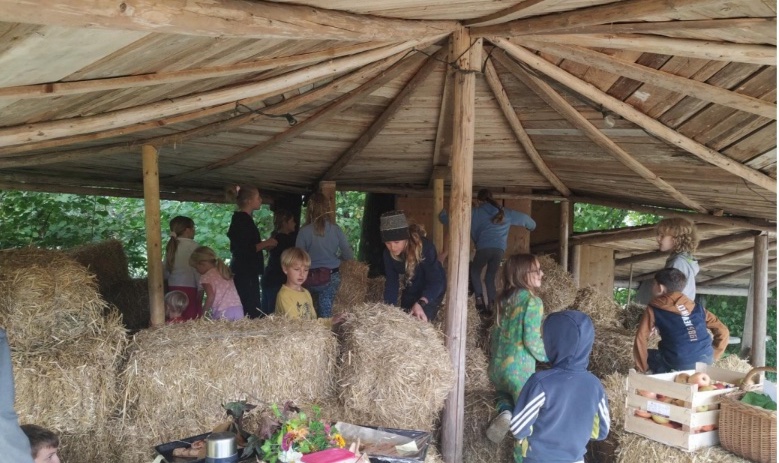
Kids playing among hay bales and in nature in Slovenia
From Anja Light in QLD, Australia:
As a long-time activist and mother, I’ve always felt responsible for bringing kids into this crazy world. But this year the tables turned a bit when my daughter Pacha brought me to Iceland – a prize for her work, which she chose to share with me. She took the wheel of our campervan and took charge of the itinerary, and I let go. She took us to the frontline of environmental and social justice battles, just as I once took her to those frontlines. She connected the dots between local struggles and the global economy, and passionately shared her understanding with her networks. And when in gale-force winds the campervan lurched like a boat at sea, she held me and I held her back.
In the jaw-dropping magnificence of the Icelandic landscape, I found solace in our young generation. They are demonstrating they have the capacity, insight, courage, resilience and power – not only to weather the coming storm, but to help guide the paradigm shift into a new (ancient futures) story.
From Samantha Salmon in Devon, UK:
I recently spotted a fly agaric mushroom (Amanita muscaria) while it was still in pristine condition, and it gave me so much joy. Especially this year, as it grew in an area where not long ago a beautiful dark pine tree forest was cut down and left a barren piece of land with sad looking tree stumps. This mushroom on the edge of this piece of land gave me hope that nature will survive and bring back life. It always does.
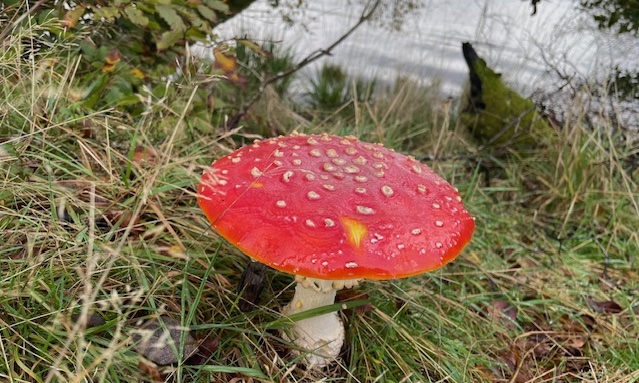
Beautiful fly agaric mushroom in Devon, UK
From Jonny Tomlinson in London, UK:
Living in central London can often feel isolating and our local communities are constantly under pressure of gentrification. Whilst sometimes I don’t feel like I have it in me to tackle the bigger picture, I try and immerse myself in the community in which I exist and I tend to believe if everybody did something positive within their local communities then they’d be considerably stronger.
There’s so much you can involve yourself in. For me and my partner both, volunteering for Age UK – whereby we visit an elderly person who is lonely on a weekly basis – has been great.
From Sally Cusack in NSW, Australia:
My children are the greatest sources of hope and motivation for me to continue looking for ways to spread the word of localization. As digital natives, I have worried many times over about how this exposure to such influential technology has influenced my kids’ emotional development and connection to nature.
However, my son (19), who has an interest in physics and astronomy, has decided to invest the next three years into a carpentry apprenticeship rather than an esoteric and distant life at university. Perhaps that will come later, but for now he wants to indulge his love of building real things. He sees building as a fundamental life skill and he wants to build his own home one day.
From Alex Jensen in the USA:
A constant and invaluable source of inspiration and solace is firstly the ineffable beauty and magnificence of all that remains of the more-than-human wild world, its power to heal (itself, and us), its antidote to the human solipsism and loneliness of the dead, fake, virtual-technological world. Its destruction, disappearance and loss – in many ways, for the very (re)production of the technosphere – is accordingly acutely painful.
Secondly, my interaction with those humans who continue in the face of such unbearable losses to live and model ‘uneconomic’ lives and ways of being that center humility, local webs of reciprocity, ecological production, sufficiency and care. For example, the small-scale ecological farmers and various care-workers and healers I met and spent some days with in Vietnam (as shown in this photo), who have alchemized the trauma and grief of being on the receiving end of imperialist war and ecological-health devastation of cataclysmic proportions into generosity, conviviality and love. This is humbling beyond belief. If we are to have a future on this precious gift of a world, it will be thanks to people like them.

Alex Jensen helping with the harvest in Vietnam
From Henry Coleman in NSW, Australia:
A short drive from my house, I can walk into a deep ravine of towering trees. The waterfalls form braided ribbons between giant ferns and create deep green pools for electric blue dragonflies. Native pigeons fill the treetops in their thousands. All this in a region that was devastated by “climate bomb” floods and fires just a couple of years ago – this river itself was scorched, flooded, and suffered numerous landslides.
So when I come here today, it is all the more clear how nature wants to thrive. Given the chance, life itself breathes the Holocene back into balance. My role in all this is not to sit in a far-removed office and hopelessly bemoan tipping-points crossed and global warming “locked in”. My role is to step outside my door and work to support the ongoing, almost-inevitable flourishing that occurs when people and nature are protected from the toxic pressures of an industrial techno-economy – that is, to campaign for localization.
From Spalzes Wangmo in Ladakh, India:
My hope for a better future comes from the resilience and creativity of all the like-minded individuals and communities I come across who are working together to address the global challenges. Increasing awareness of social and environmental issues and a growing commitment to sustainability and equity suggests that positive change is very much possible. Here in Ladakh there is a clear increase in the number of young people becoming activists and being actively engaged in shaping our societies. This brings hope that the future generations will prioritize compassion, inclusion and responsible stewardship of the planet.
From Helena Norberg-Hodge in NSW, Australia:
I’ve just come back from a wonderful permaculture event with families, children and many dear friends and colleagues, including Costa Georgiadis, Brenna Quinlan and Charlie Mgee, who have been passionately and merrily promoting permaculture for many years. Every time I’m in touch with the community building around soil and seed, my heart is full of joy. It’s so clearly healing and it’s happening. It’s happening despite the fact that people have been trained into narrow specialization and pushed to go into the city to be “important” professionals. Despite enormous psychological and financial pressures in the opposite direction, there is a move, there is a cultural turning. And there are those who argue that it’s culture that ultimately shapes politics and even geopolitics.
That’s what I’m counting on.
Browse our Local Futures blog here. Top photo by Richard Wang on Unsplash