
An Eco-Farm in Myanmar (Burma): Saving the World with Organic Agriculture
 The sun has risen over a misty, damp plain where, not long ago, wild elephants roamed. We have walked home through fallow paddy fields after a hot cup of tea at the little teahouse on the road to the monastery. It is the cool season and we can see our breath in the air of the kitchen as we eat our fried rice. Someone is singing a traditional song – it reminds them of home. Another shoos the ducklings out of the potato plants. A few people have been up since 4:30 AM to light the fire and cook breakfast. The dogs are wrestling in a pile of sand that has been dumped in anticipation of the new mud brick building, and nearby a rooster crows. The morning watering has begun and the sun, getting higher now, is casting shadows. An old, dusty copy of The Permaculture Handbook sits on a desk. Soon it will be time to start classes.
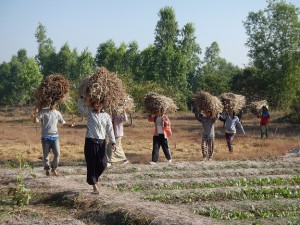 I am on an eco-farm in southern Myanmar (Burma). This residential, educational facility – the first of its kind in Myanmar – is set on 5 acres of land in a rural area about 50 km northwest of Yangon. It was established in February 2013 by the Network for Environment and Economic Development (NEED), a grassroots organisation created in 2006 by environmentalist and educator Khaing Dhu Wan. The organisation initially operated out of an eco-farm in Chiang Mai, in northern Thailand, but is now transitioning into Myanmar. The farm and the NEED program are an attempt to act as a catalyst for progressive change in the country.
 NEED works from the perspective of sustainable livelihoods, focusing on issues such as food security, land tenure and rights, community development and organizing. NEED works to address perpetual food insecurity at the village level, as well as the lack of knowledge and capacity to deal with local bio-diversity loss and environmental degradation. After listening to the needs of communities, NEED’s training program was developed as a way to help communities restore their agriculture-based livelihoods and socio-economic opportunities.
The first cohort of 25 students, young adults from various ethnic groups and regions of Myanmar, started in June 2013 and graduated (with great ceremony) in March 2014. Before starting the program, the students already had direct experience of local environmental and food security issues such as de-forestation, water pollution, loss of mangrove, over-fishing, and soil erosion. They came to the eco-farm to learn how to address these problems.
The 10-month environmental program developed by NEED is focused on sustainable, organic farming practices – in particular the concept of permaculture. Students are also taught about alternative building practices like mud-brick, renewable energy sources such as solar power and bio-gas, waste management, water strategies, alternative livelihoods, community development, leadership skills, environmentalism, English, and computer and internet skills. They are also encouraged to critically analyze prevailing economic, political and social structures and institutions and to develop peaceful and practical alternatives.
Students are supported in transferring their new skills and knowledge to their villages and communities. Their newly acquired techniques can enhance traditional practices, and assist their communities in becoming more diversified, empowered and resilient. NEED believes that its agriculture training program has the potential to indirectly reach dozens of communities and thousands of people. As Myanmar transitions towards democracy, it is my hope that political, economic and social reforms will open up spaces for the involvement of a growing civil society – including initiatives like the NEED eco-farm and its adult environmental education program.


Author: Johanna Garnett

Author: Local Futures

Hello,
we support and try to build environmental adult and child education . We use it as a tool of socio-ecological transformation in Asia (Thailand, Laos, Cambodia) and we want to add Myanmar. Our mission is to build food security and community resilience thru a group of like minded people.
Hi!
This is Than Shwe, Program Office, from NEED-Myanmar. We would like to cooperate any organization with the same/ similar vision. We are also trying to get a international partner who can support and any kind of help and cooperation for what we believe for the grass root community development
you can reach me at ([email protected]) .
Thank you!